
You’re Not Alone — And You Don’t Have to Figure This Out by Yourself
Let’s be honest for a second.
You’ve probably Googled “how to get fit” more than once. You’ve watched YouTube videos, scrolled through Instagram workout reels, and maybe even bought a gym membership you’ve barely used. And yet — here you are, still not sure where to actually begin.
That confusion? Completely normal. The fitness world can feel overwhelming, full of conflicting advice, impossible-looking bodies, and workouts designed for people who already look like athletes.
But here’s the truth: everyone starts as a beginner. The difference between the people who transform their health and the ones who stay stuck is simply having the right guide to follow.
That’s exactly what this beginner fitness guide is for.
By the time you finish reading, you’ll know:
- Why fitness is more powerful than most people realize
- How to build a workout routine that actually fits your life
- What to eat, how to rest, and how to stay motivated
- The most common mistakes beginners make — and how to avoid every single one
Whether you’re working out at home, heading to the gym for the first time, or just trying to move your body more — this beginner fitness guide has you covered. Let’s walk through exactly how to start working out for beginners, step by step.
Why Fitness Matters — Especially If You’re Just Starting Out
Before we talk about how to work out, let’s talk about why it’s worth doing in the first place.
Because motivation without meaning doesn’t last long.
Physical Benefits You’ll Start Noticing Quickly
When you begin exercising consistently, your body starts changing in ways that go far beyond just looking different in the mirror:
- More energy throughout the day — regular movement improves circulation and oxygen delivery to your cells
- Better sleep — people who exercise fall asleep faster and sleep more deeply
- Stronger muscles and bones — resistance training increases bone density, reducing the risk of injury and osteoporosis
- Improved heart health — even moderate cardio lowers blood pressure and reduces the risk of heart disease
- Easier weight management — a higher muscle mass increases your resting metabolic rate, so you burn more calories even at rest
- A stronger immune system — regular moderate exercise helps your body fight off illness more effectively
You don’t need to work out for hours every day to see these benefits. Studies consistently show that even 150 minutes of moderate activity per week — that’s just 21 minutes a day — makes a significant difference.
Mental and Emotional Benefits That Are Just as Important
Here’s what doesn’t get talked about enough in any beginner fitness guide: fitness is one of the most powerful tools for mental health that exists.
Exercise releases endorphins — chemicals your brain produces that reduce stress and create feelings of happiness. It also lowers cortisol (the stress hormone), boosts self-confidence, reduces symptoms of anxiety and depression, and gives you a sense of accomplishment that builds over time.
When you’re starting this beginner fitness guide journey, these mental wins often come before the physical ones — and they’re just as worth celebrating.
How to Start Working Out: A Step-by-Step Guide
This is the section most people skip straight to — and that’s completely fine. Every solid beginner fitness guide starts here: the how. Let’s walk through exactly how to build your workout life from scratch.
Step 1: Set Clear, Realistic Goals
The first question to ask yourself is: Why do I want to get fit?
Your answer shapes everything — what workouts you do, how often you train, and how you’ll measure success.
Common beginner goals include:
- Losing weight or reducing body fat
- Building muscle and getting stronger
- Having more energy and feeling healthier
- Reducing stress or improving mental health
- Training for a specific event (5K, hiking trip, etc.)
Once you know your why, set a specific goal. Not “I want to get fit” — but something like “I want to lose 15 pounds in 4 months” or “I want to do 10 push-ups without stopping in 6 weeks.”
Specific goals give you direction. And direction makes you far more likely to actually show up.
Step 2: Choose Your Workout Environment — Home or Gym?
Both home workouts and gym training can get you outstanding results. The best choice is the one you’ll actually stick with.
Home Workouts Are Great If You:
- Feel intimidated by the gym environment
- Have a tight schedule or unpredictable hours
- Want to save money on membership fees
- Prefer privacy while you’re learning the basics
You don’t need equipment to get started at home. Bodyweight exercises — push-ups, squats, lunges, planks — are incredibly effective and completely free.
The Gym Is a Better Fit If You:
- Thrive with structure and a dedicated “workout space”
- Want access to weights, machines, and cardio equipment
- Find it easier to focus when you’re away from home distractions
- Enjoy being around others who are working toward similar goals
Many beginners start at home and transition to the gym once they’ve built some confidence and consistency. Either path works — what matters most is simply starting.
Step 3: Understand the Core Workout Types
A well-rounded fitness routine for beginners includes three types of training:
1. Cardiovascular Exercise (Cardio) Activities that raise your heart rate: walking, jogging, cycling, swimming, jump rope, dancing. Cardio improves heart and lung health, burns calories, and boosts mood.
2. Strength Training (Resistance Training) Using your bodyweight or weights to challenge your muscles. Builds lean muscle, increases metabolism, improves posture, and strengthens bones.
3. Flexibility and Mobility Work Stretching, yoga, or foam rolling. Reduces injury risk, improves range of motion, and helps with recovery.
As a beginner, you don’t need to master all three right away. But understanding them helps you build a balanced routine over time.
Step 4: Create a Weekly Schedule
Consistency beats intensity every single time. Especially when you’re just starting out.
Aim for 3–4 workout days per week as a beginner. More than that can lead to burnout or injury before you’ve built a strong foundation.
Here’s a simple weekly structure to start with:
- Monday: Strength training (full body)
- Tuesday: Rest or light walk
- Wednesday: Cardio (20–30 minutes)
- Thursday: Rest or yoga/stretching
- Friday: Strength training (full body)
- Saturday: Active rest (hiking, bike ride, casual swim)
- Sunday: Full rest
This gives your muscles time to recover while keeping you active most days of the week. Rest days are not laziness — they’re essential for progress.
Beginner Workout Plan: Your First 4 Weeks
This beginner workout plan is designed specifically for people who are new to exercise. No equipment is required, though dumbbells can be added as you get stronger.
Before every workout: 5–10 minute warm-up (jumping jacks, arm circles, leg swings, light jogging in place) After every workout: 5–10 minute cool-down (static stretching — hold each stretch 20–30 seconds)
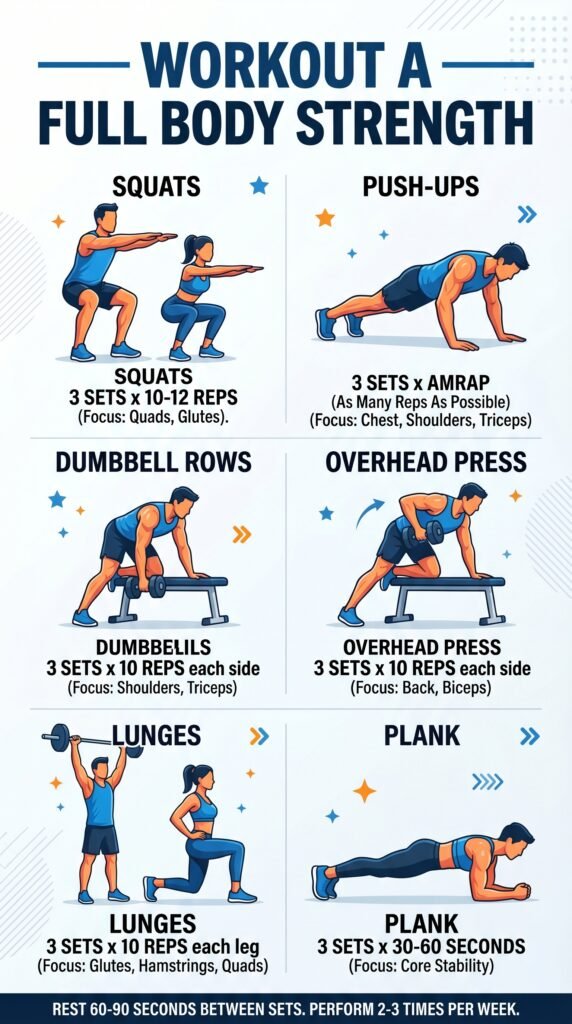
🏋️ Workout A — Full Body Strength (Monday & Friday)
| Exercise | Sets | Reps | Rest |
|---|---|---|---|
| Bodyweight Squats | 3 | 12–15 | 60 sec |
| Push-Ups (or knee push-ups) | 3 | 8–12 | 60 sec |
| Reverse Lunges | 3 | 10 each leg | 60 sec |
| Dumbbell Rows (or band rows) | 3 | 10–12 | 60 sec |
| Glute Bridges | 3 | 15 | 45 sec |
| Plank Hold | 3 | 20–30 sec | 45 sec |
Progression Tip: When you can complete all reps with good form, add 1 more rep or 5 seconds to your plank. Slow and steady progress beats going too hard too soon.
🏃 Workout B — Cardio + Core (Wednesday)
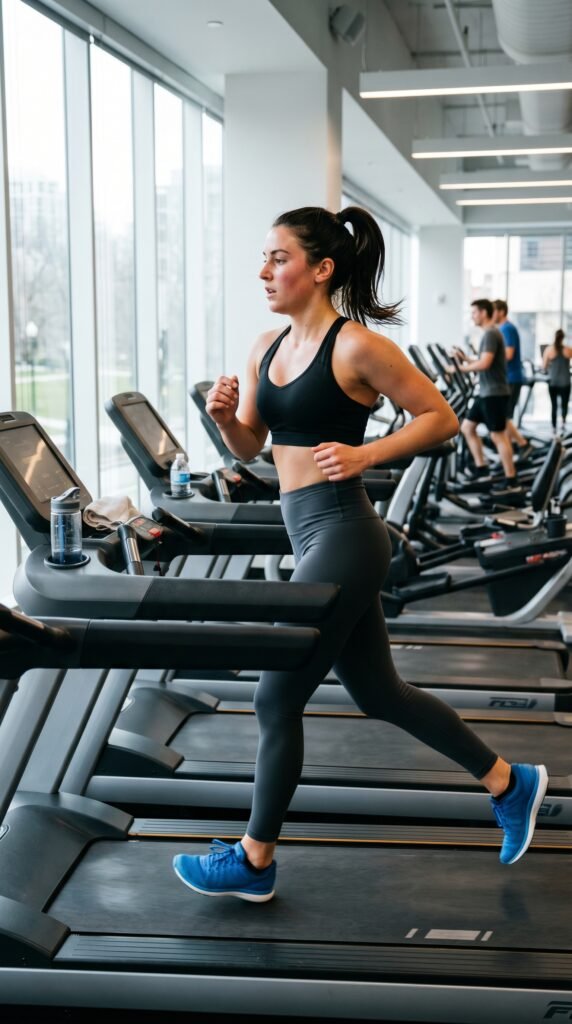
Cardio Option 1 (Outdoors or Treadmill):
- Walk briskly for 5 minutes → jog for 1 minute → walk for 2 minutes → repeat 5 times → walk 5 minutes to cool down
- Total time: ~25–30 minutes
Cardio Option 2 (Home — No Equipment):
Perform each exercise for 40 seconds, rest for 20 seconds. Complete 3 rounds:
- Jumping Jacks
- High Knees
- Mountain Climbers
- Step Touches (low impact option)
- Butt Kicks
Core Circuit (after cardio):
| Exercise | Sets | Duration/Reps | Rest |
|---|---|---|---|
| Dead Bug | 2 | 8 each side | 45 sec |
| Bicycle Crunches | 2 | 15 each side | 45 sec |
| Superman Hold | 2 | 10 reps (hold 2 sec) | 45 sec |
| Side Plank | 2 | 20 sec each side | 45 sec |
📅 4-Week Progression Plan
| Week | Workout A | Workout B | Goal |
|---|---|---|---|
| Week 1 | 2 sets per exercise | 2 cardio rounds | Learn movements, build habit |
| Week 2 | 3 sets per exercise | 3 cardio rounds | Add volume |
| Week 3 | 3 sets, add reps | Increase cardio time by 5 min | Build endurance |
| Week 4 | 3 sets, heavier if available | Full workouts as written | Establish baseline fitness |
After 4 weeks, reassess your goals and either repeat with increased intensity, or move to a slightly more challenging intermediate beginner workout plan.
Essential Fitness Tips Every Beginner Needs to Know
This beginner fitness guide wouldn’t be complete without covering the fundamentals that most people overlook — and that make the difference between progressing smoothly and getting sidelined by injury.
Always Warm Up (Yes, Every Single Time)
A proper warm-up increases your heart rate, warms your muscles, and improves joint mobility before you put them under stress. Skipping it is one of the fastest ways to get injured.
Spend 5–10 minutes doing:
- Light cardio (walking, jogging in place)
- Dynamic stretches (leg swings, hip circles, arm rotations)
- Movement practice (a few slow reps of exercises you’re about to do)
Cool Down and Stretch Afterward
After your workout, your heart rate needs to gradually return to normal. A proper cool-down also helps remove metabolic waste products from your muscles, reducing soreness.
Hold each stretch for at least 20–30 seconds — focus on the muscle groups you just worked. Never bounce in a stretch; keep it slow and controlled.
Learn Proper Form Before Adding Weight
Bad form leads to bad injuries. And bad injuries set your progress back by weeks or months.
Before you increase weight or intensity, make sure you’ve mastered the movement pattern. Watch videos from certified trainers [link to form guide article], use a mirror to check your positioning, and when in doubt — go lighter.
Listen to Your Body
There’s a difference between the discomfort of a challenging workout (muscle fatigue, burning sensation — this is normal) and pain that signals injury (sharp pain, joint pain, anything that feels wrong).
If something hurts — stop. Don’t push through pain. Rest, apply ice if needed, and consult a professional if it persists.
Prioritize Sleep and Recovery
Your muscles don’t grow during workouts — they grow during rest. Sleep is when your body repairs muscle tissue, replenishes energy stores, and releases growth hormone.
Aim for 7–9 hours per night. If you’re training hard and sleeping poorly, you’re leaving most of your progress on the table.
Nutrition Basics: Fueling Your Fitness Journey
You don’t need a complicated meal plan to see results. But you do need to understand a few fundamentals — because what you eat either supports your workouts or works against them. This beginner fitness guide covers the basics so you don’t have to guess.
Protein: Your Most Important Macronutrient
Protein is the building block of muscle. Without enough of it, your body can’t repair and build the muscle tissue you’re breaking down in your workouts.
Beginner target: 0.7–1 gram of protein per pound of bodyweight per day.
Good sources of protein include:
- Chicken breast, turkey, and lean beef
- Eggs and egg whites
- Greek yogurt and cottage cheese
- Salmon and tuna
- Legumes (lentils, chickpeas, black beans)
- Protein shakes (a convenient supplement, not a replacement for whole food)
Carbohydrates: Your Body’s Preferred Fuel
Carbs get a bad reputation, but they’re your body’s primary energy source — especially during exercise. The key is choosing the right ones.
Focus on complex carbohydrates: oats, brown rice, sweet potatoes, whole grain bread, fruits, and vegetables. These digest slowly and provide sustained energy without blood sugar spikes.
Save simple carbs (like fruit or white rice) for right around your workout, when fast energy is actually useful.
Healthy Fats: Don’t Skip Them
Fats support hormone production, joint health, and brain function. Include sources like avocado, olive oil, nuts, seeds, and fatty fish in your diet.
Hydration: The Most Overlooked Performance Factor
Even mild dehydration can significantly reduce workout performance and recovery. Most people simply don’t drink enough water.
Target: At least 8–10 cups (2–2.5 liters) of water per day, more on days you exercise heavily.
Drink a glass of water before your workout, sip during, and prioritize rehydrating afterward.
Keep It Simple
You don’t need to track every calorie or follow a strict meal plan as a beginner. Instead, focus on:
- Eating mostly whole, unprocessed foods
- Getting protein at every meal
- Limiting ultra-processed snacks and sugary drinks
- Not skipping meals — especially before or after workouts
[Link to nutrition for beginners article]
Common Mistakes Beginners Make (And How to Avoid Them)
Even with the best intentions — and the best beginner fitness guide — most people fall into the same traps. Here’s how to sidestep them from day one.
Mistake #1: Doing Too Much, Too Soon
Excitement is powerful at the start of a starting fitness journey. But going from zero to six days a week of intense training is a recipe for burnout, injury, and quitting.
Fix: Start with 3 days a week. Build the habit first, then add intensity.
Mistake #2: Skipping Rest Days
More is not always better in fitness. Your muscles need 48–72 hours of recovery after strength training to repair and grow stronger. Skipping rest means you’re training on a fatigued body — which reduces results and increases injury risk.
Fix: Schedule rest days the same way you schedule workouts. They’re part of the program.
Mistake #3: Ignoring Warm-Up and Cool-Down
It feels like a waste of time when you’re eager to get into your workout. But this “wasted” 10 minutes prevents the weeks of recovery time that injuries can cost you.
Fix: Make warm-up and cool-down non-negotiable parts of every session.
Mistake #4: Comparing Yourself to Others
Scrolling through fitness influencers’ accounts while you’re just starting out is motivation poison. Those people have often been training for years. Their current state is not your starting point.
Fix: Compare yourself only to who you were last week. Progress is personal.
Mistake #5: Expecting Overnight Results
Real, lasting physical change takes time. Most beginners start feeling better within 2–3 weeks, and seeing visible changes around 6–8 weeks of consistent training.
Fix: Set process goals (show up 3x per week) instead of only outcome goals (lose 20 pounds). The outcomes will follow the process.
Mistake #6: Neglecting Nutrition
You can’t out-train a poor diet. If you’re eating in ways that don’t support your goals, even perfect workouts won’t get you far.
Fix: Focus on the basics — enough protein, mostly whole foods, adequate hydration. You don’t need perfection, just consistency.
How to Stay Motivated When the Excitement Fades
Here’s something no beginner fitness guide warns you about enough: the initial excitement always fades. Usually around week 3 or 4.
This is completely normal — and it’s the exact moment that separates people who transform their health from those who quit and start over next January.
Build a Routine, Not Just Motivation
Motivation is an emotion — it comes and goes. Routine is a system — it runs whether you feel like it or not.
Schedule your workouts like appointments. Put them in your calendar. Lay out your workout clothes the night before. Lower the friction to the point where not doing it feels harder than doing it.
Track Your Progress — In Multiple Ways
The scale is just one data point. And for many beginners, it’s not even the most meaningful one.
Track your progress by also noting:
- How many push-ups you can do now vs. when you started
- How your energy levels feel throughout the day
- How your clothes fit
- How your sleep quality has changed
- Your mood and stress levels
- Your resting heart rate over time
When you see progress in multiple areas, you stay motivated even when one metric isn’t moving.
Find Accountability
Tell a friend or family member your goal. Join an online fitness community [link to community]. Find a workout partner. Hire a coach or personal trainer — someone who can act as a living beginner fitness guide and keep you accountable.
Accountability dramatically increases follow-through. When someone else knows your goal, your brain is more committed to it.
Celebrate Small Wins
Did you complete all 3 workouts this week? That’s a win. Did you choose the stairs instead of the elevator? Win. Did you drink 8 glasses of water for the first time? Win.
Celebrating small progress builds momentum. Momentum builds consistency. Consistency builds results.
Make It Enjoyable
You don’t have to do workouts you hate. If running is misery for you — don’t run. Try cycling, swimming, dancing, martial arts, rock climbing, or team sports.
The best workout is the one you actually show up for, week after week.
FAQs: Beginner Fitness Questions Answered
Q1: How many days a week should a beginner work out?
For most beginners, 3–4 days per week is ideal. This gives your body enough stimulus to adapt and improve, while allowing adequate recovery time between sessions. As your fitness improves over several months, you can gradually increase to 4–5 days if you’d like. Consistency over a moderate schedule beats sporadic intense training every time.
Q2: How long should beginner workouts be?
Start with 30–45 minutes per session, including warm-up and cool-down. You don’t need to spend 2 hours in the gym to see results — especially as a beginner. Quality of movement and consistency of effort matters far more than duration. As your fitness level improves, you can extend sessions if desired.
Q3: Do I need equipment to work out at home?
No equipment is needed to get started. Bodyweight exercises — squats, push-ups, lunges, planks, glute bridges — are effective for building strength and improving fitness. If you want to add resistance over time, a set of resistance bands or adjustable dumbbells are the most cost-effective investments for home training.
Q4: Should I do cardio or strength training first?
If your primary goal is fat loss or general fitness, prioritize strength training and add cardio after (or on separate days). If your goal is cardiovascular endurance (like training for a race), do cardio first. For most beginners following this fitness guide for beginners, doing strength before cardio typically gives better results because you’ll have more energy for the movements that require focus and form.
Q5: How long before I start seeing results?
You’ll likely feel results (more energy, better sleep, improved mood) within 2–3 weeks. Visible physical changes — changes others can notice — typically take 6–12 weeks of consistent training and proper nutrition. Results vary based on starting fitness level, genetics, diet, sleep, and how consistently you train. Trust the process and don’t expect miracles in the first two weeks.
Q6: Is it normal to feel sore after working out?
Yes — especially in the first few weeks. This is called Delayed Onset Muscle Soreness (DOMS), and it’s a normal response to new physical stress. It typically peaks 24–48 hours after exercise and fades within 3–5 days. Light activity (walking, gentle stretching) on sore days can actually speed up recovery. However, if the pain is sharp, localized to a joint, or doesn’t improve after a week — see a healthcare professional.
Q7: What should I eat before and after a workout?
If you’re wondering how to start working out for beginners on the nutrition side, pre- and post-workout meals are a great place to focus first.
Before (1–2 hours prior): A light meal or snack with carbs and protein. Examples: banana with peanut butter, oatmeal with berries, or a small chicken and rice bowl.
After (within 30–90 minutes): Focus on protein and carbs to support muscle repair and replenish energy stores. Examples: protein shake with fruit, Greek yogurt with granola, or eggs with whole grain toast.
Conclusion: Your Journey Starts With a Single Step
You now have everything you need to begin.
A beginner fitness guide is only valuable if you actually use it. And the best time to start is not Monday, not next month, not when life calms down — it’s today. Even if “today” just means putting on your shoes and going for a 20-minute walk.
Every person you’ve ever admired for their fitness was once exactly where you are right now — at the beginning, unsure, a little nervous, wondering if they could actually do it.
They could. And so can you.
Here’s what to do right now:
- ✅ Decide: home workouts or gym?
- ✅ Block 3 days this week for your workouts
- ✅ Try Workout A from this guide today
- ✅ Drink a glass of water right now
- ✅ Bookmark this page and come back every week
This is your starting fitness journey — and it’s one of the best decisions you’ll ever make for yourself. You’ll be stronger, healthier, more energetic, and more confident than you’ve ever been.
Now go get started. You’ve already taken the first step by reading this far.
⭐ Top Pick: #3 — “The Only Beginner Fitness Guide You’ll Ever Need” Combines authority (“only”), completeness (“ever need”), and directly addresses the keyword. High emotional pull for beginners overwhelmed by conflicting information.