
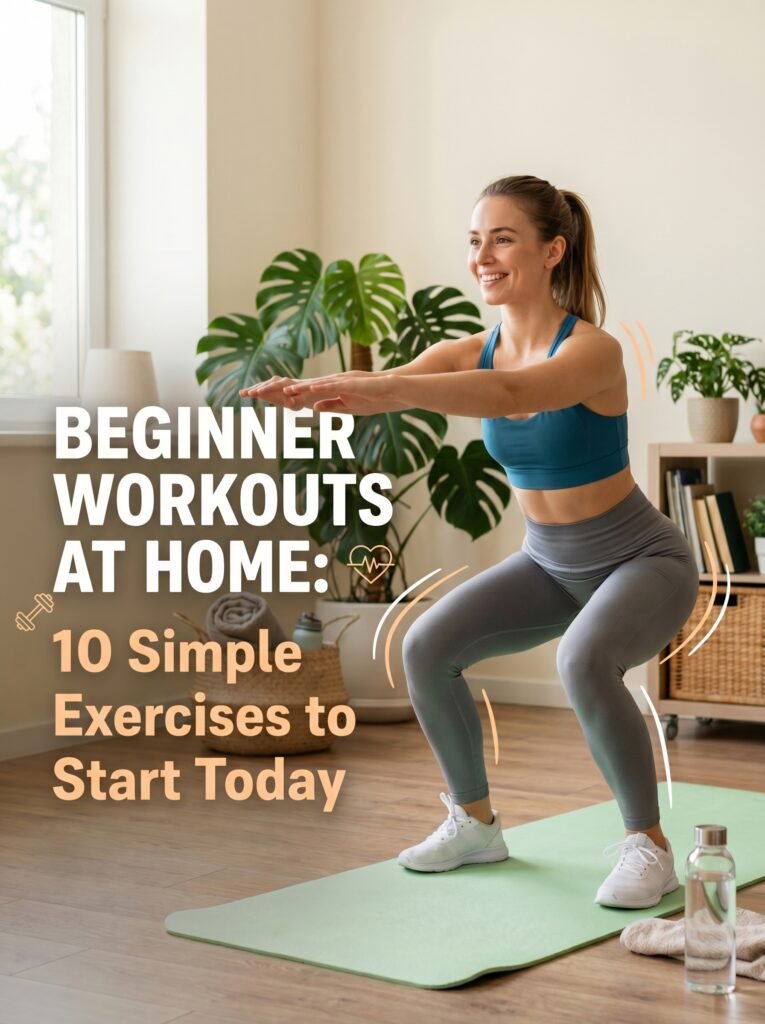
Introduction
You’ve told yourself you’ll “start getting fit” more times than you can count. But then life gets in the way — you’re tired after work, the gym feels intimidating, and you don’t even know where to begin.
Here’s the truth: you don’t need a gym membership, expensive equipment, or an hour of free time to get in shape. You need a plan, a little floor space, and the willingness to start.
Beginner workouts at home are one of the most powerful — and most underrated — ways to begin a fitness journey. No judgment, no crowds, no commute. Just you, your body, and real results.
Whether you want to lose weight, build strength, boost your energy, or simply feel better in your own skin, this guide is your starting point. You’ll find 10 simple, effective exercises that require zero equipment, a beginner-friendly weekly plan, and everything you need to actually stay consistent this time.
Let’s go.
📋 Quick Summary
What you’ll get from this article:
- Why beginner workouts at home are the smartest way to start fitness
- The real benefits of working out from home (they go beyond weight loss)
- What to know before your first workout
- 10 simple, step-by-step exercises perfect for complete beginners
- A full sample weekly plan you can follow immediately
- Common beginner mistakes — and how to avoid them
- Tips to stay consistent and actually build a lasting habit
- Answers to the 5 most common beginner questions
Why Beginner Workouts at Home Are Perfect for Starting Fitness
Walk into most gyms as a beginner and you’re immediately faced with unfamiliar machines, people who look like they’ve been training for years, and zero idea what to actually do. It’s overwhelming — and it sends a lot of people straight back to the couch.
Beginner workouts at home eliminate that barrier completely.
When you work out at home, you’re in your own space. You move at your own pace. You make mistakes without an audience. And because there’s no commute, no membership fee, and no waiting for equipment, the excuses that usually derail beginners simply disappear.
More importantly, home-based fitness works. Your body doesn’t know whether you’re in a gym or your living room — it only responds to the effort you put in. And for beginners, bodyweight exercises are not only sufficient, they’re actually ideal. They build strength, endurance, coordination, and flexibility while teaching your body to move properly before you ever add external weight.
If you’ve been waiting for the “perfect time” to start, beginner workouts at home are that perfect start. Low barrier, high reward — exactly what you need right now.
Benefits of Working Out at Home
Before we get into the exercises, it’s worth understanding why this approach is so effective — especially for people who are just starting out.
💰 It’s completely free No gym fees, no equipment costs. Your bodyweight is genuinely all you need to build real fitness as a beginner.
⏰ It saves time There’s no commute, no waiting for machines, and no time pressure. You can work out in 20–30 minutes and get back to your day. That’s one of the biggest reasons people stick with beginner workouts at home long term.
🏠 It’s private and comfortable You can wear what you want, pause when you need to, and make mistakes in private. That comfort is underrated — it removes self-consciousness and lets you focus entirely on the work.
📈 It builds a genuine foundation Bodyweight training develops real functional strength, mobility, and body awareness. These are the building blocks that make everything else — if and when you add weights or join a gym — far more effective.
🧠 It reduces stress and boosts mood Exercise releases endorphins. Even a 20-minute home workout for beginners can dramatically improve your mood, mental clarity, and stress levels — often within the same day you do it.
🔄 It’s flexible and scalable Start with 2 days a week. Build to 4. Add intensity as you get stronger. Home fitness grows with you — and it never requires you to sign anything or wait in a queue.
Tips Before Starting Beginner Workouts at Home
Ready to begin? Before you jump into the first exercise, take 2 minutes to read these. They’ll save you time, prevent injury, and set you up for consistent results.
Clear a safe space You need roughly 6 feet by 4 feet of clear floor space. Move any furniture, check for slippery surfaces, and if possible, use a yoga mat or exercise mat for floor exercises.
Wear supportive footwear You don’t need fancy trainers — but some kind of supportive shoe helps with exercises that involve jumping or lateral movement. Socks alone on a hard floor are a slip risk.
Warm up for 3–5 minutes first Never jump straight into exercise cold. A brief warm-up increases blood flow, loosens joints, and reduces injury risk. Simple warm-up: march in place for 60 seconds, do 10 arm circles, 10 hip circles, and 5 slow squats.
Start slower than you think you should This is the single biggest beginner mistake. You feel motivated on day one and push too hard — then you can barely walk for three days and lose momentum. Start easier than feels necessary. Form and consistency matter far more than intensity at this stage.
Listen to your body There’s a difference between the healthy discomfort of working hard and the sharp pain of injury. If something hurts (not burns — hurts), stop and rest.
Stay hydrated Keep a water bottle nearby and sip throughout. Even light exercise causes fluid loss, and dehydration reduces performance and recovery.
Track what you do Write down or log your workouts — even in a basic notebook. Seeing your progress over weeks is one of the strongest motivators to keep going.
10 Simple Workouts for Beginners at Home
These beginner workouts at home cover your full body, require zero equipment, and are deliberately ordered from lower to higher intensity. Do them in sequence as a circuit, or pick your favorites to build a personalized routine.
1. Jumping Jacks
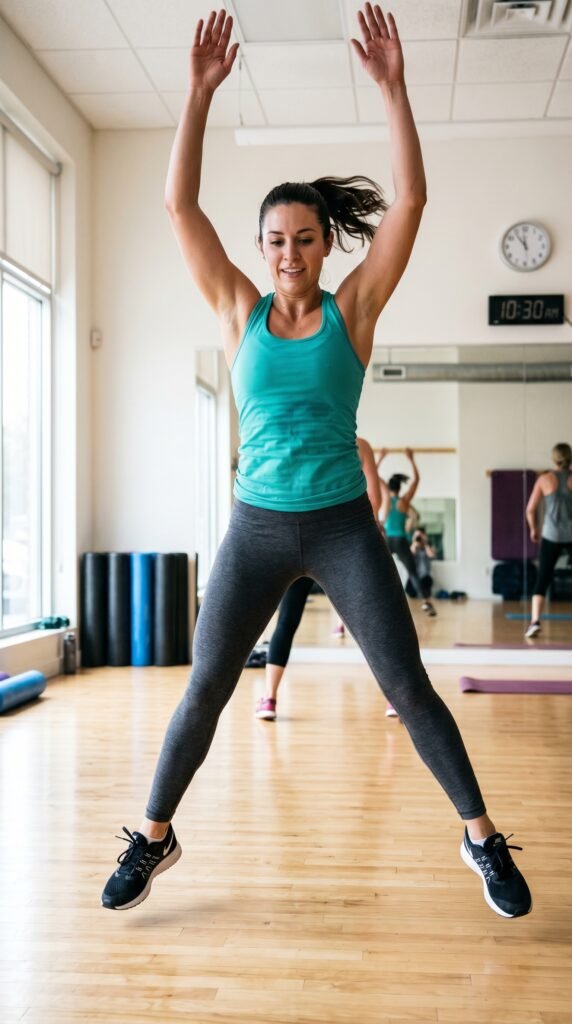
A full-body warm-up and cardio classic — the perfect opener for any beginner session.
Step-by-step instructions:
- Stand with your feet together and arms at your sides.
- Jump slightly, spreading your feet shoulder-width apart while raising your arms above your head.
- Jump again, returning to the starting position.
- Repeat continuously in a smooth, controlled rhythm.
Duration: 3 sets of 30 seconds, with 20 seconds rest between sets.
Benefits: Elevates heart rate, warms up the entire body, improves coordination, and burns calories efficiently for a simple exercise.
💡 Beginner tip: If jumping feels too intense on your joints, try the low-impact version — step one foot out at a time instead of jumping. Same arm movement, same benefits, lower impact.
2. Bodyweight Squats
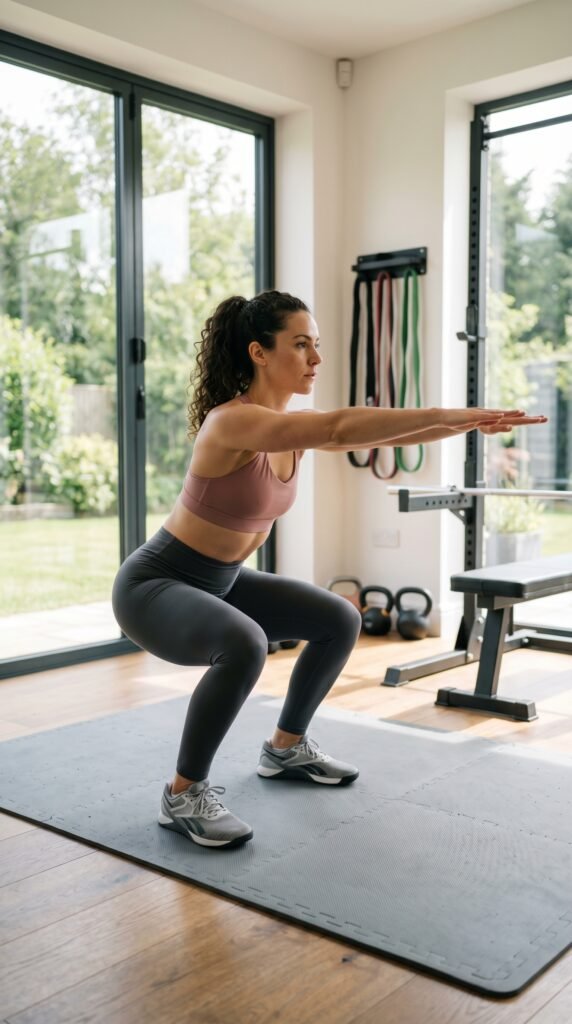
The king of lower body exercises — and one of the most functional movements your body performs every day.
Step-by-step instructions:
- Stand with feet shoulder-width apart, toes pointing slightly outward.
- Keep your chest up and your core gently engaged.
- Push your hips back and bend your knees, lowering until your thighs are parallel to the floor (or as low as is comfortable).
- Drive through your heels to return to standing.
- Squeeze your glutes briefly at the top.
Duration: 3 sets of 10–15 reps.
Benefits: Builds strength in the quads, glutes, and hamstrings. Improves knee stability, mobility, and posture. One of the highest-value exercises in any beginner fitness routine at home.
💡 Beginner tip: If your knees cave inward as you lower, widen your stance slightly and focus on pushing your knees out over your toes.
3. Modified Push-Ups (Knee Push-Ups)
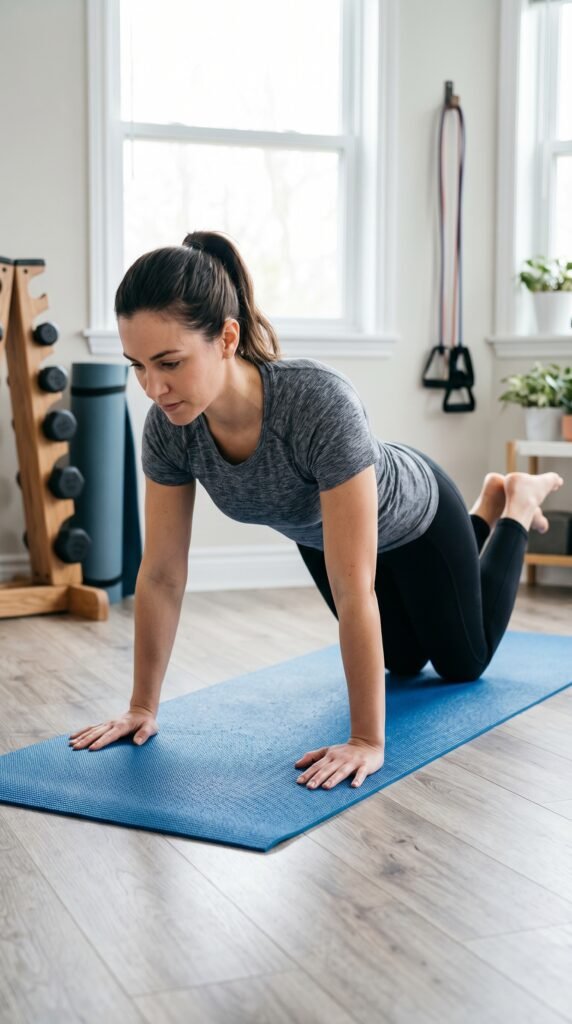
Push-ups build real upper body strength — and the modified version makes them achievable for complete beginners.
Step-by-step instructions:
- Start on all fours, with your hands slightly wider than shoulder-width.
- Lower your hips so your body forms a straight line from your knees to your shoulders (knees stay on the floor).
- Bend your elbows and lower your chest toward the floor — elbows at roughly 45 degrees from your body.
- Push back up to the starting position.
Duration: 3 sets of 8–12 reps.
Benefits: Builds chest, shoulder, and tricep strength. Strengthens the core. Develops the pushing pattern that transfers to countless daily movements.
💡 Beginner tip: Focus on keeping your core tight and your hips in line — don’t let them sag or pike upward. Quality reps matter far more than quantity.
4. Plank
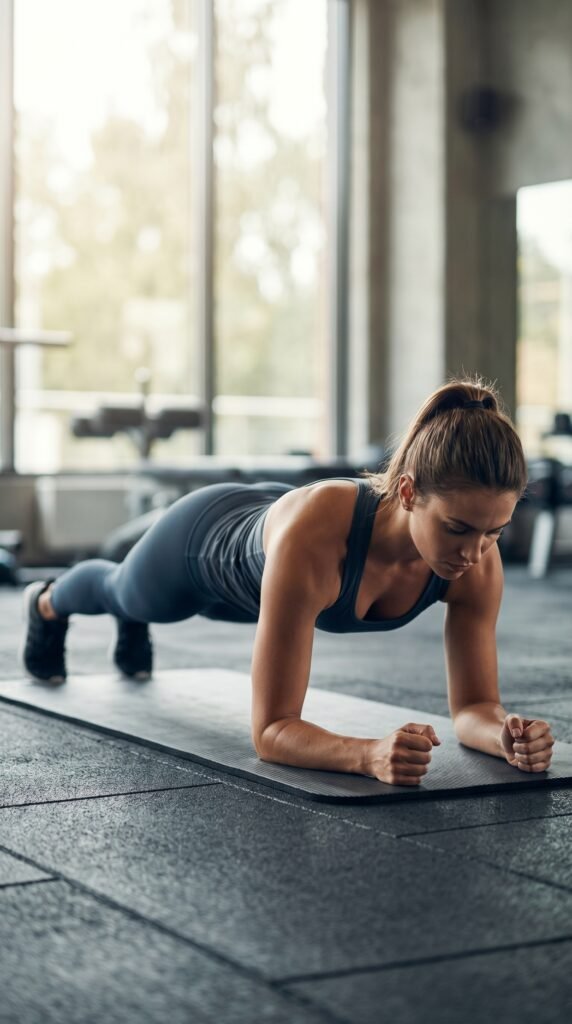
One of the most effective core exercises that exists — and the most beginner-accessible version of all.
Step-by-step instructions:
- Start on your forearms and knees (or toes for a greater challenge).
- Align your elbows directly beneath your shoulders.
- Engage your core, squeeze your glutes, and create a straight line from your head to your knees (or heels).
- Breathe normally. Hold the position.
Duration: 3 sets of 15–30 seconds, building toward 60 seconds over time.
Benefits: Builds core stability, strengthens the entire midsection, improves posture, and supports virtually every other exercise you’ll ever do.
💡 Beginner tip: If you feel your lower back sagging, drop to your knees immediately. A 15-second perfect plank beats a 60-second sloppy one every time.
5. Reverse Lunges
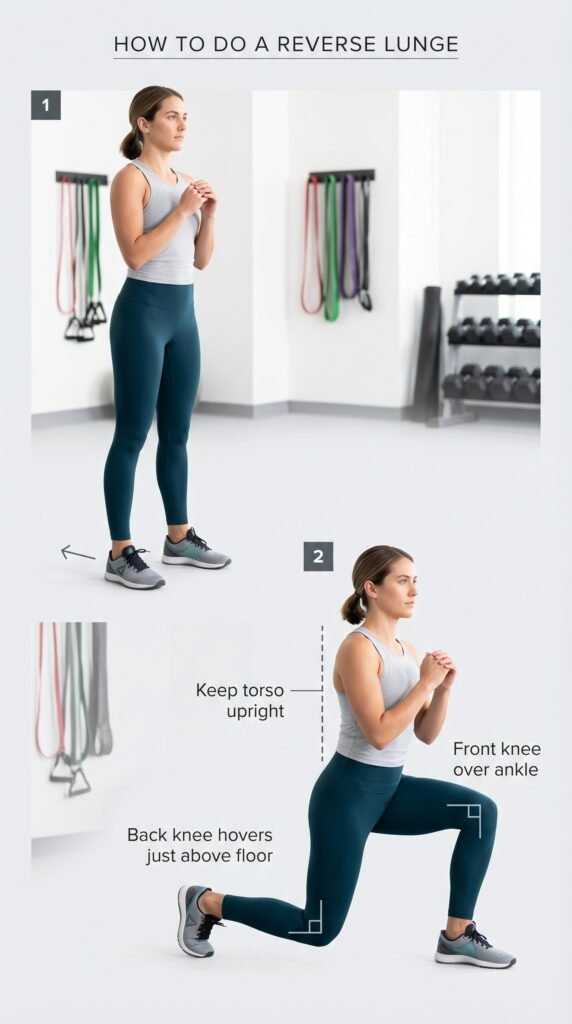
Lunges train each leg independently — building balance, coordination, and lower body strength simultaneously.
Step-by-step instructions:
- Stand tall with feet hip-width apart.
- Step one foot backward, lowering your back knee toward (but not touching) the floor.
- Your front thigh should be roughly parallel to the ground.
- Push through your front heel to return to standing.
- Alternate legs with each rep.
Duration: 3 sets of 8–10 reps per leg.
Benefits: Strengthens glutes, quads, and hamstrings. Improves balance and hip flexibility. The reverse lunge (stepping back rather than forward) is gentler on the knees than the standard version — ideal for no equipment workouts for beginners.
💡 Beginner tip: Keep your front knee tracking directly over your toes throughout the movement. Use a wall for balance support if needed.
6. High Knees
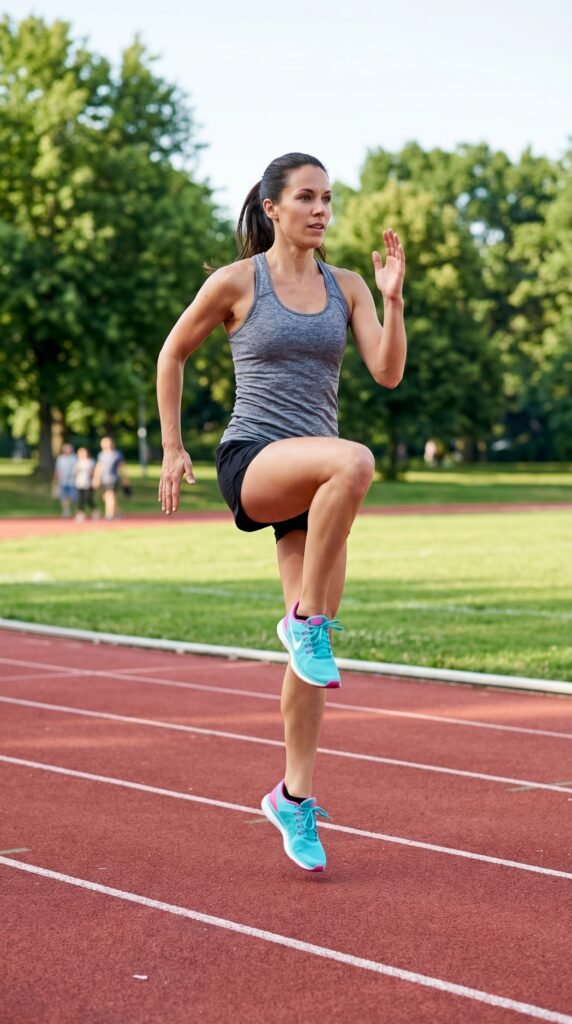
A dynamic cardio exercise that raises your heart rate and challenges your coordination — no space required.
Step-by-step instructions:
- Stand with feet hip-width apart.
- Begin jogging in place, driving each knee up toward your chest as high as comfortable.
- Pump your arms in rhythm with your legs (opposite arm to opposite knee).
- Land lightly on the balls of your feet to protect your joints.
Duration: 3 sets of 20 seconds, with 20 seconds rest.
Benefits: Elevates heart rate quickly, burns calories, improves hip flexor strength, coordination, and cardiovascular endurance.
💡 Beginner tip: Speed matters less than knee height. Focus on driving your knees up and landing softly rather than going as fast as possible.
7. Glute Bridges
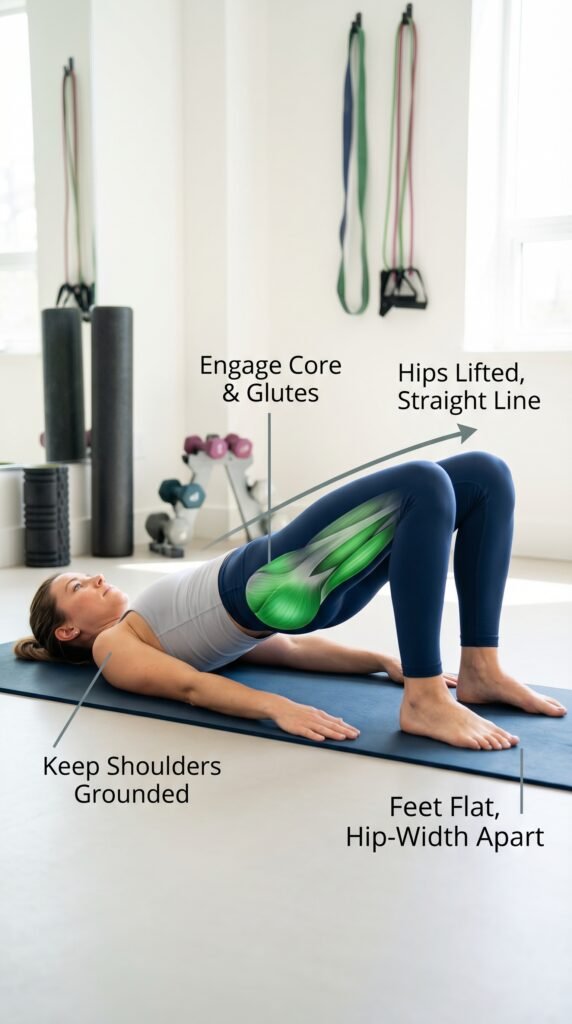
An underrated powerhouse exercise that targets the glutes and lower back — critical muscles for posture, power, and pain prevention.
Step-by-step instructions:
- Lie on your back with knees bent and feet flat on the floor, hip-width apart.
- Place your arms flat at your sides.
- Press through your heels and squeeze your glutes to raise your hips toward the ceiling.
- Hold briefly at the top — your body should form a straight line from knees to shoulders.
- Slowly lower your hips back down.
Duration: 3 sets of 12–15 reps.
Benefits: Activates and strengthens the glutes, hamstrings, and lower back. Counteracts the hip flexor tightness caused by sitting all day. One of the safest and most effective simple home exercises for beginners.
💡 Beginner tip: Focus on the squeeze at the top. If you feel it more in your lower back than your glutes, move your feet slightly closer to your hips.
8. Wall Sit
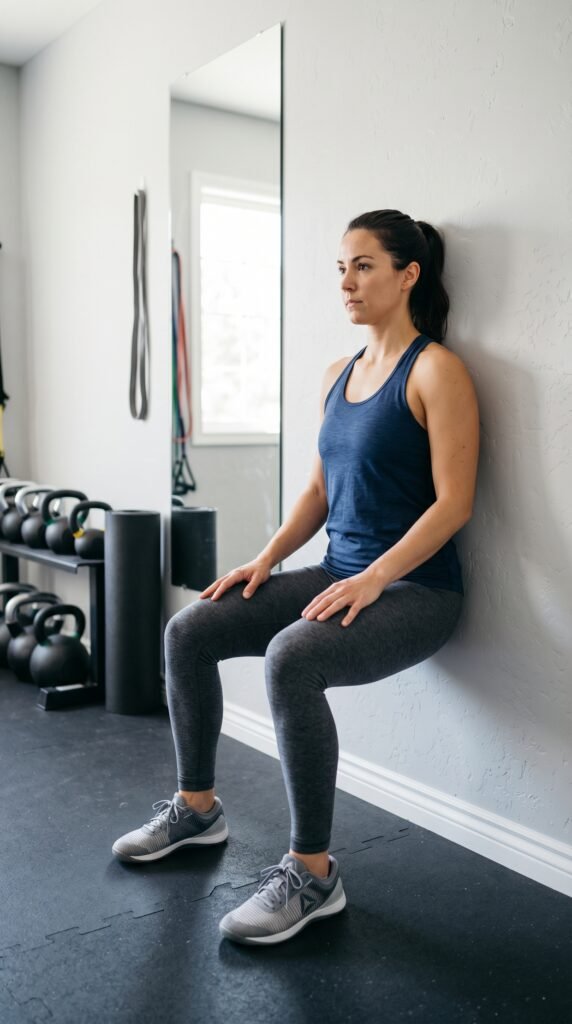
Simple, brutal, and incredibly effective — the wall sit builds leg endurance and mental toughness simultaneously.
Step-by-step instructions:
- Stand with your back flat against a wall.
- Slide down until your thighs are parallel to the floor (or as low as you can manage).
- Your feet should be hip-width apart, knees directly above your ankles.
- Keep your back flat against the wall throughout.
- Hold the position, breathing steadily.
Duration: 3 sets of 20–45 seconds, with 30 seconds rest.
Benefits: Builds quad strength and endurance, engages the core, improves knee stability, and teaches your body to handle sustained muscular discomfort — a skill that transfers to every other exercise.
💡 Beginner tip: If parallel feels too intense, go shallower — even a 100-degree angle will challenge your legs. The goal is controlled discomfort, not agony.
9. Mountain Climbers

A full-body exercise that combines core work, upper body strength, and cardio into a single movement.
Step-by-step instructions:
- Start in a high plank position — hands directly beneath your shoulders, body in a straight line.
- Drive one knee toward your chest, keeping your hips level.
- Return it to the starting position and immediately drive the opposite knee forward.
- Alternate in a smooth, controlled rhythm — or faster for a cardio challenge.
Duration: 3 sets of 20 seconds, building toward 40 seconds.
Benefits: Strengthens the core, shoulders, and arms. Elevates heart rate significantly. Challenges coordination and full-body stability all at once — one of the highest-value exercises in any beginner workouts at home routine.
💡 Beginner tip: Slow it down to a pace where you can keep your hips level and your core engaged. A slow, controlled mountain climber is more effective than a fast, sloppy one.
10. Standing Marches
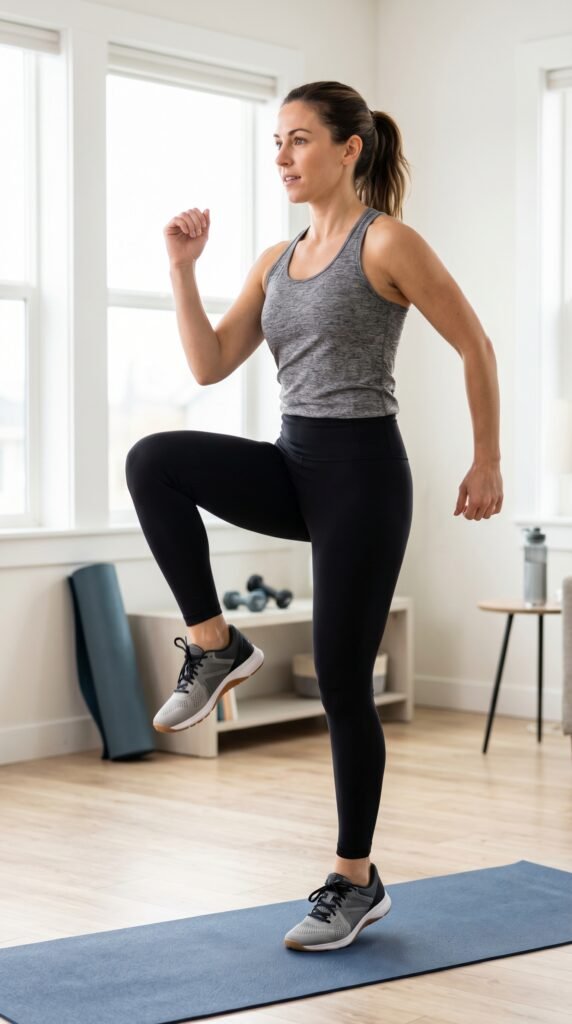
The perfect finisher — a low-intensity movement that keeps blood flowing, supports active recovery, and is accessible to absolutely everyone.
Step-by-step instructions:
- Stand tall with feet hip-width apart.
- Lift your right knee to hip height (or as high as comfortable), while swinging your left arm forward.
- Lower and repeat on the opposite side.
- March in a steady, rhythmic pattern.
Duration: 2–3 minutes of continuous marching to cool down, or 3 sets of 30 seconds as a warm-up.
Benefits: Improves hip flexor strength and mobility, supports circulation and active recovery, and serves as a gentle warm-up or cool-down bookend for any session.
💡 Beginner tip: Focus on posture throughout — stand tall, engage your core lightly, and swing your arms naturally. This exercise is as much about body awareness as it is about movement.
Beginner Fitness Routine at Home: Your Sample Weekly Plan
The exercises above are most powerful when organized into a structured routine. Here’s a simple, balanced weekly plan designed specifically for beginner fitness routine at home practice — no equipment, no gym, no guesswork.
The Rule: Three days on, one day off. Rest days are not optional — they’re when your muscles actually adapt and grow stronger.
🗓️ Week 1–2: Foundation Phase (Build the Habit)
| Day | Session | Exercises |
|---|---|---|
| Monday | Full Body A | Jumping Jacks → Squats → Modified Push-Ups → Plank → Glute Bridges |
| Tuesday | Rest | Light walking, gentle stretching |
| Wednesday | Full Body B | High Knees → Reverse Lunges → Mountain Climbers → Wall Sit → Standing Marches |
| Thursday | Rest | Light walking, foam rolling if available |
| Friday | Full Body A | Repeat Monday’s session |
| Saturday | Active Recovery | 20-minute walk outdoors |
| Sunday | Full Rest | Recovery and preparation for the week ahead |
Format for each exercise:
- 3 sets per exercise
- Rest 30–45 seconds between sets
- Rest 60 seconds between exercises
- Total session time: 20–30 minutes
🗓️ Week 3–4: Progress Phase (Build the Intensity)
By now, the exercises should feel more manageable. Time to push slightly:
- Increase reps by 2–3 per set across all exercises
- Reduce rest between sets to 20–30 seconds
- Add a 4th exercise set to any exercise that feels easy
- Try combining Full Body A and Full Body B into a single longer session once per week
The beauty of beginner workouts at home is that progression is always in your hands.
Common Mistakes Beginners Should Avoid
Even motivated beginners make these errors. Knowing them in advance puts you miles ahead.
❌ Skipping the warm-up Jumping straight into squats or push-ups with cold muscles and joints is a fast route to injury. Three to five minutes of light movement makes every subsequent exercise safer and more effective.
❌ Doing too much too soon The excitement of a new routine can push beginners to do seven days a week in the first week. Then soreness sets in, motivation crashes, and the routine ends. Start with 3 sessions per week and build from there.
❌ Prioritizing speed over form Sloppy reps are worse than no reps. Poor form trains your body to move incorrectly — which reduces results and increases injury risk. Slow down, focus on technique, and trust that quality movement produces quality results.
❌ Ignoring rest days Rest is not laziness. Your muscles grow and strengthen during recovery, not during the workout itself. Skipping rest days blunts your progress and increases the risk of burnout and overuse injury.
❌ Comparing yourself to others Progress in home workout for beginners is deeply personal. Someone else’s Week 4 is not your Week 4. Your only competition is the version of you from last week.
❌ Quitting after one missed day Missing a session doesn’t erase your progress. What matters is consistency over time — not perfection. Get back to it tomorrow and keep going.
How to Stay Consistent with Beginner Workouts at Home
Knowing the exercises is the easy part. Showing up consistently, especially in the early weeks, is what actually produces results. Here’s what actually works:
Schedule it like an appointment Pick specific days and times for your workouts and add them to your calendar. Treat them with the same commitment you’d give a meeting or a doctor’s appointment. “I’ll work out when I have time” almost never happens.
Start with sessions you can finish A 20-minute workout you complete beats a 60-minute one you abandoned. Start with achievable sessions. Success breeds motivation — and motivation builds momentum.
Track your progress visibly Use a simple journal, a phone note, or even a paper calendar to track every completed session. Seeing a chain of checkmarks is surprisingly motivating — and the fear of “breaking the chain” can push you through low-motivation days.
Pair it with an existing habit Habit stacking is one of the most research-backed consistency tools available. Do your beginner workouts at home right after your morning coffee, before your shower, or immediately after work. Attaching a new habit to an existing one dramatically increases follow-through.
Prepare the night before Lay out your clothes. Clear your workout space. Decide exactly which exercises you’ll do. Removing all friction from the decision lowers the barrier to starting significantly.
Find an accountability partner Tell a friend, join an online community, or share your workouts on social media. Public commitment increases follow-through — and having someone to check in with makes the difficult days easier.
Remember why you started Write it down — your actual reason for wanting to get fit. Put it somewhere you’ll see it on the mornings when your motivation is low. Discipline starts motivation. Reminders sustain it.
FAQs About Beginner Workouts at Home
Q1: How many days a week should beginners work out at home?
For true beginners, 3 days per week is the sweet spot. It’s enough to build momentum and see progress without overwhelming your body before it has adapted. As your fitness improves — typically after 4–6 weeks — you can gradually increase to 4 or 5 days. The sample plan above is built around this principle.
Q2: Do beginner workouts at home actually produce real results?
Absolutely — and the science is clear on this. Bodyweight training at home builds muscle, burns fat, improves cardiovascular fitness, and enhances flexibility and mobility. The results you get depend on consistency and progressive effort, not on the location or equipment. Many people have completely transformed their fitness with nothing but no equipment workouts for beginners and a clear plan.
Q3: How long should each beginner home workout session be?
Start with 20–30 minutes per session. This is more than enough to produce real results for a beginner. As your fitness improves and your recovery gets faster, you can gradually extend to 40–45 minutes. The goal in the first few weeks is building the habit — not exhausting yourself.
Q4: Is it normal to feel sore after beginner workouts at home?
Yes — particularly in the first 2–3 weeks. This is called DOMS (Delayed Onset Muscle Soreness) and it’s a normal response to new physical stress. It typically peaks 24–48 hours after a workout and fades within 72 hours. Light movement (walking, gentle stretching) on rest days actually speeds up recovery. However, sharp or joint pain is different — that warrants rest and possibly a doctor’s visit.
Q5: Do I need to eat differently when starting beginner workouts at home?
You don’t need to overhaul your diet overnight — but a few basic nutrition principles will accelerate your results significantly. Increase your protein intake (aim for 1.2–1.6g per kg of body weight), stay well hydrated, and try to eat mostly whole, minimally processed foods. Avoid crash dieting — your body needs fuel to perform and recover.
🔗 See also: 10 Healthy Breakfast Recipes for Weight Loss
Q6: What if I can’t do a full workout? Is a short session worth it?
Absolutely. A 10-minute session is infinitely better than zero minutes. If you’re short on time, pick 3–4 exercises from the list, do 2 sets each, and count it as a win. Building the consistency of showing up — even briefly — matters more than session length in the early stages.
Conclusion
You don’t need a gym. You don’t need equipment. You don’t even need a lot of time.
What you need is a decision — and you’ve already made it by reading this far.
Beginner workouts at home are the most accessible, most forgiving, and most flexible way to begin a fitness journey. The 10 exercises in this guide will build real strength, burn real calories, and create real change in your body — all from the comfort of your own home.
Start with the sample weekly plan. Do 3 sessions this week. Don’t worry about being perfect. Don’t compare yourself to anyone. Just show up, do the work, and trust the process.
The first two weeks are always the hardest — not because the exercises are impossibly difficult, but because the habit isn’t built yet. Push through that window and everything changes. The workouts start to feel familiar. Your body starts to respond. And your confidence grows in a way that nothing else quite replicates.
Three sessions from now, you’ll feel different. Three months from now, you’ll look different. And a year from now, you’ll be glad you started with this exact article, on this exact day.
Your home gym is ready. Your body is capable. The only thing left is to begin. 💪