

Introduction
You’ve decided to get fit. Maybe you’re tired of feeling sluggish. Maybe you looked in the mirror one morning and decided something had to change. Or maybe a friend’s transformation inspired you to finally take that first step.
Whatever brought you here, that decision is the most important thing you’ll do today.
But here’s what nobody tells you about starting a fitness journey: the hardest part isn’t the workouts. It’s the confusion. Which exercises should you do? How often? How hard? What should you eat? Do you need a gym? Will you even stick with it?
If those questions feel overwhelming, you’re not alone. Almost every fit person you admire started in exactly the same place — unsure, uncertain, and a little scared.
This guide cuts through all of that noise. These fitness tips for beginners are practical, science-backed, and built for real people with real lives — not professional athletes or people with hours to spare every day.
By the time you finish reading, you’ll have everything you need to start with confidence, progress without injury, and build a fitness habit that actually lasts.
Let’s begin.
📋 Quick Summary
What you’ll find in this article:
- Why fitness matters beyond weight loss — and why now is the right time to start
- A clear, simple guide on how to start a fitness journey from zero
- 12 detailed, actionable fitness tips for beginners — each one designed to build on the last
- A practical beginner weekly workout plan you can follow this week
- The most common beginner mistakes — and exactly how to avoid them
- Proven strategies to stay consistent and motivated long-term
- Answers to the 5 most common beginner fitness questions
Why Fitness Is Important for Beginners
Here’s a question worth sitting with for a moment: what do you actually want from fitness?
Most beginners answer “to lose weight” — and that’s a completely valid goal. But the benefits of regular exercise go so much deeper than the number on a scale, and understanding this changes everything about how you approach the journey.
Regular physical activity — even gentle, beginner-level exercise — has been shown to:
- Dramatically improve mental health — Exercise is one of the most powerful antidepressants known to science. It releases endorphins, serotonin, and dopamine — the brain chemicals responsible for mood, motivation, and wellbeing.
- Increase energy levels — Counterintuitively, moving your body more gives you more energy throughout the day, not less. Your cardiovascular system becomes more efficient and fatigue decreases.
- Improve sleep quality — People who exercise regularly fall asleep faster, sleep more deeply, and wake up feeling more rested.
- Reduce the risk of serious disease — Regular movement significantly lowers the risk of Type 2 diabetes, cardiovascular disease, certain cancers, and metabolic syndrome.
- Build confidence and self-respect — Showing up for your health consistently — even imperfectly — creates a powerful sense of agency and self-belief that spills into every other area of life.
These aren’t abstract promises. They’re measurable, documented outcomes that begin showing up within weeks of starting a consistent routine.
Fitness tips for beginners aren’t just about getting a better body. They’re about building a better life — and the sooner you start, the sooner every area of your wellbeing improves.
How to Start a Fitness Journey: Simple Step-by-Step
Before diving into the 12 tips, it helps to understand the overall roadmap. How to start a fitness journey can feel like a massive question — but broken into steps, it becomes surprisingly simple.
Step 1: Define your “why” Be specific. “I want to feel more energetic by my daughter’s birthday in three months” is far more powerful than “I want to get fit.” A concrete reason anchors you when motivation dips.
Step 2: Set one small, measurable goal Not “get fit” — something like “complete three 20-minute workouts this week.” Small, achievable goals build the confidence and momentum you need to tackle bigger ones.
Step 3: Choose your starting format Home workouts, gym, outdoor running, swimming, group classes — pick whatever feels most accessible and least intimidating right now. You can change it later. Starting is what matters.
Step 4: Plan your first week Decide exactly which days you’ll work out, what you’ll do, and for how long. Specificity turns vague intentions into actual action.
Step 5: Begin — imperfectly if necessary Don’t wait for the perfect moment, the perfect plan, or the perfect body to start. The perfect moment is now. Progress begins with imperfect action.
Follow these steps alongside the fitness tips for beginners below, and you’ll have a complete foundation for lasting change.
12 Fitness Tips for Beginners
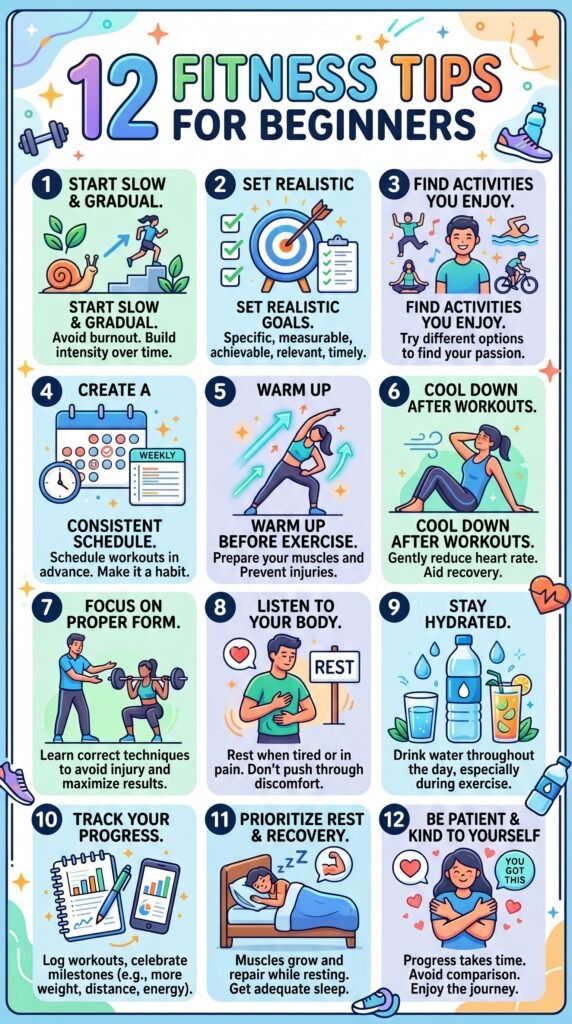
This is the core of everything. These fitness tips for beginners are ordered intentionally — each one builds on the one before it. Read them all before starting, then come back to this section as your regular reference guide.
Tip 1: Start Small and Be Ruthlessly Consistent
The single most important of all fitness tips for beginners — and the one most people ignore.
When you’re motivated and excited, your instinct is to do everything at once. Seven days a week. Two-hour sessions. Complete diet overhaul. It feels productive. Within two weeks, you’re burned out, sore, and back on the couch.
The research on habit formation is unambiguous: small, consistent actions build durable habits far more effectively than large, sporadic bursts of effort.
Start with three 20-minute sessions per week. That’s it. Show up for those three sessions every single week for a month. Then increase. The goal in week one isn’t transformation — it’s the habit of showing up.
Apply this immediately: Schedule your three sessions right now. Put them in your calendar with a specific time. Treat them like non-negotiable appointments.
Tip 2: Master Proper Form Before Adding Intensity
Nothing derails a beginner’s fitness journey faster than an injury caused by poor technique. And nothing causes poor technique faster than going too heavy, too fast, too soon.
Form is the foundation of everything. A squat performed incorrectly doesn’t just fail to build your legs — it builds compensatory movement patterns that lead to knee and back problems down the line. A push-up with a sagging core trains your body to move wrong.
Before you worry about how many reps you’re doing or how much weight you’re lifting, focus entirely on how you’re moving.
Apply this immediately: For each exercise you do this week, watch one proper-form tutorial video before starting. Move slowly, feel what’s activating, and prioritize quality over quantity in every session.
Tip 3: Create a Simple, Repeatable Workout Routine
Beginners often make the mistake of trying a different workout every day — endlessly scrolling for new YouTube videos, trying new apps, switching programs weekly. The variety feels exciting. In reality, it prevents progress.
Your body adapts to specific stimuli. Repeating the same core exercises week over week is how you get measurably stronger, fitter, and more coordinated. Variety is a tool for advanced athletes — consistency is the tool for beginners.
Build a simple routine of 5–8 exercises that cover your full body. Stick with it for at least 4–6 weeks before changing anything significant.
Apply this immediately: Choose 5 exercises from the beginner list below (squats, push-ups, lunges, plank, glute bridges are a solid foundation). That’s your routine for the next month.
🔗 See also: 12 Low Calorie Breakfasts Under 300 Calories You’ll Love
Tip 4: Always Warm Up — Every Single Time
Skipping warm-ups is one of the most common beginner mistakes. It feels like wasted time when you’re eager to get into the “real” workout. But a proper warm-up is not optional — it’s what separates productive training from injury risk.
A 3–5 minute warm-up increases blood flow to your muscles, raises your core temperature, lubricates your joints, and mentally prepares you for the session ahead. Cold muscles are stiffer, weaker, and more prone to strain.
A simple beginner warm-up:
- 60 seconds of marching in place
- 10 arm circles (forward and backward)
- 10 slow bodyweight squats
- 10 hip circles each direction
- 30 seconds of light jumping jacks
That’s it. Five minutes that make every subsequent exercise safer and more effective.
Tip 5: Stay Hydrated Throughout Every Session
This fitness tip for beginners sounds basic — because it is. And yet dehydration is one of the most common, most easily preventable reasons for poor workout performance, excessive fatigue, and prolonged soreness.
Even mild dehydration (as little as 1–2% of body weight in fluid loss) reduces strength, endurance, concentration, and coordination. You feel it as excessive tiredness, dizziness, or an overwhelming urge to stop.
The fix is straightforward: drink water before, during, and after exercise. You don’t need sports drinks or electrolyte tablets for most beginner-level workouts — plain water is perfect.
Apply this immediately: Place a full water bottle next to wherever you work out before your session begins. The visual cue alone dramatically increases how much you drink.
Tip 6: Prioritize Sleep Like It’s Part of Your Training
Here’s something most fitness tips for beginners articles don’t tell you: your muscles don’t grow during your workout. They grow during recovery — specifically during deep sleep.
When you exercise, you create microscopic tears in your muscle fibers. Sleep is when your body repairs those fibers, making them thicker and stronger. Without adequate sleep (7–9 hours for most adults), this repair process is incomplete. You get weaker, more fatigued, and more injury-prone — despite putting in the work.
Sleep also regulates hunger hormones. Poor sleep elevates ghrelin (the hunger hormone) and suppresses leptin (the satiety hormone), leading to cravings and overeating that can undermine your fitness goals.
Apply this immediately: Set a consistent bedtime — even on weekends. Prioritize it with the same seriousness you give your workout schedule.
Tip 7: Track Your Progress (Even Simply)
What gets measured gets improved. One of the most powerful fitness tips for beginners that nobody takes seriously enough is keeping a record of what you do.
You don’t need a sophisticated app or a detailed spreadsheet. A small notebook works perfectly. After each session, write down: what you did, how many reps, how it felt. That’s it.
Over weeks, you’ll notice you’re doing more reps, recovering faster, and feeling stronger. That visible progress is one of the most motivating forces in fitness — and you can’t see it without a record.
Tracking options for beginners:
- A basic pocket notebook
- Notes app on your phone
- Free apps like Strong, MyFitnessPal, or Strava
- A simple wall calendar with a checkmark for each completed session
The method doesn’t matter. The consistency of tracking does.
Tip 8: Fuel Your Body with Balanced Meals
Exercise and nutrition are inseparable. You can follow every other fitness tip for beginners perfectly — but if your diet is primarily processed food, sugar, and empty calories, your results will be dramatically limited.
You don’t need to follow a rigid diet or count every calorie. For beginners, a few simple principles make an enormous difference:
- Eat enough protein — Aim for 1.2–1.6g per kilogram of bodyweight. Protein builds and repairs muscle, reduces hunger, and supports fat loss.
- Eat mostly whole foods — Vegetables, fruits, whole grains, lean proteins, and healthy fats. Limit processed foods where possible.
- Don’t skip meals — Especially around your workout. A small meal or snack 1–2 hours before exercise gives you the fuel to perform. A protein-rich meal within 1–2 hours after helps recovery.
- Avoid extreme restriction — Crash dieting while exercising is counterproductive. Your body needs fuel to adapt and improve.
🔗 See also: 10 Healthy Breakfast Recipes for Weight Loss
Tip 9: Be Patient — Results Take Real Time
This might be the hardest fitness tip for beginners to accept — but it’s also the most important for long-term success.
Real, sustainable fitness progress doesn’t happen in a week. Or two weeks. Or even four weeks. Here’s a realistic timeline:
- Weeks 1–2: Your nervous system adapts. Exercises start to feel less foreign. You might notice slight improvements in endurance.
- Weeks 3–4: Your cardiovascular fitness improves noticeably. You recover faster between sets.
- Weeks 6–8: Visible muscle definition begins to appear. Clothes fit differently. Energy levels have improved significantly.
- Months 3–6: Substantial body composition changes become visible to others. Strength gains are measurable and consistent.
The people who fail at fitness almost always quit somewhere in weeks 2–4, right before results begin to appear. Understanding this timeline keeps you going when progress feels slow.
Apply this immediately: Write today’s date and a brief description of how you currently feel physically. Open it in 90 days. The difference will surprise you.
Tip 10: Avoid the Most Common Beginner Mistakes
Several mistakes are so common among beginners that they deserve a dedicated tip. Knowing these in advance puts you miles ahead.
The biggest mistakes to avoid:
- Doing too much too soon — More is not better in the early stages. More is often worse.
- Ignoring rest days — Rest days are training days for your recovery system. They’re not optional.
- Copying advanced athletes — That influencer’s workout was designed for someone with years of adaptation. Start where you are, not where they are.
- Expecting linear progress — Some weeks you’ll regress. That’s normal. Progress over months, not days.
- Relying on motivation alone — Motivation fluctuates. Systems and scheduled commitments are what carry you through the days when motivation is gone.
Tip 11: Find What Actually Keeps You Motivated
Motivation is not a personality trait — it’s a skill that you build deliberately. The fitness tips for beginners who stick with it long-term don’t have superhuman willpower. They’ve simply figured out what works for them.
What keeps people going is deeply personal:
- Some people thrive with a workout partner or accountability buddy
- Others need a playlist that makes them feel unstoppable
- Some respond to visible tracking — a workout log or progress photos
- Many need a clear goal with a deadline (a race, a holiday, a wedding)
- Others do best with a reward system — a new piece of clothing after a milestone month
Experiment with all of these. Find your combination. Then build your environment around it.
Apply this immediately: Identify one thing that would make your next workout slightly more enjoyable — a new playlist, a workout partner, a new exercise to try. Add it this week.
Tip 12: Make Fitness a Lifestyle, Not a Phase
The final and perhaps most transformative of all fitness tips for beginners: stop thinking of fitness as a temporary project you’re doing until you reach a goal.
The people with the best long-term results are the ones who stopped asking “how long do I have to do this?” and started asking “how do I make this part of who I am?”
That identity shift changes everything. You stop relying on motivation to show up. You stop treating rest days as failures. You stop abandoning the routine when life gets busy — because the routine is your life.
Building fitness identity starts with small commitments kept consistently. Every time you show up when you don’t feel like it, you cast a vote for the person you’re becoming. Over time, those votes add up to a completely different relationship with your body and your health.
Apply this immediately: Replace “I’m trying to get fit” with “I’m someone who exercises regularly.” Say it to yourself. Mean it. Let it shape how you make decisions.
Beginner Workout Tips: A Practical Routine to Start With
Theory is valuable — but what you actually need is a plan you can start today. Here are the beginner workout tips that professionals consistently give to people just starting out, organized into a practical weekly structure.
🗓️ Beginner Weekly Workout Plan
| Day | Focus | Exercises | Duration |
|---|---|---|---|
| Monday | Full Body | Squats × 3 sets, Push-ups × 3 sets, Plank × 3 holds, Glute Bridges × 3 sets | 25–30 min |
| Tuesday | Rest / Walk | 20–30 min easy walk outdoors | Active recovery |
| Wednesday | Full Body | Reverse Lunges × 3 sets, Mountain Climbers × 3 sets, Wall Sit × 3 holds, Jumping Jacks × 3 sets | 25–30 min |
| Thursday | Rest | Full rest or gentle stretching | Recovery |
| Friday | Full Body | Repeat Monday’s session, adding 1–2 reps per exercise | 25–30 min |
| Saturday | Active Recovery | Yoga, swimming, cycling, or walking | 20–40 min |
| Sunday | Full Rest | Recovery, meal prep, planning next week | — |
Format for each workout session:
- Warm up for 3–5 minutes (march, arm circles, slow squats)
- Complete each exercise with 30–45 seconds rest between sets
- Rest 60 seconds between different exercises
- Cool down with 3–5 minutes of gentle stretching
Progressive overload principle: Each week, try to add 1–2 reps to each set, reduce rest by 5 seconds, or add one extra set to one exercise. Small, consistent increases produce steady, measurable progress.
🔗 See also: 10 Simple Workouts for Beginners at Home
Common Mistakes Beginners Should Avoid
We covered several mistakes within the 12 tips — but these deserve their own section because they’re so consistently damaging to beginner results.
Mistake #1: Setting unrealistic expectations Social media is flooded with 30-day transformation photos that are misleading at best and dishonest at worst. Expecting dramatic visible change in four weeks sets you up for disappointment and quitting. Real transformations take 3–6 months of consistent effort.
Mistake #2: Following an advanced program from day one The programs used by experienced athletes are not appropriate for beginners. They involve volumes and intensities that your body isn’t yet adapted for. Always start with beginner-specific content — like the plan in this article.
Mistake #3: Neglecting the basics to chase “optimization” Beginners often get caught up in advanced questions — should I train fasted? Which protein powder? What’s the optimal rep range? None of these matter until the basics are in place: consistent training, adequate protein, proper sleep, and progressive effort.
Mistake #4: Treating rest days as setbacks Missing a workout and immediately scheduling a makeup session on your rest day is counterproductive. Rest days exist because recovery is part of training. Honor them.
Mistake #5: Comparing your beginning to someone else’s middle The person at the gym doing things you can’t yet do has months or years of practice. Your timeline is your own. Comparison at this stage is not motivating — it’s demoralizing. Eyes on your own journey.
How to Stay Consistent and Motivated
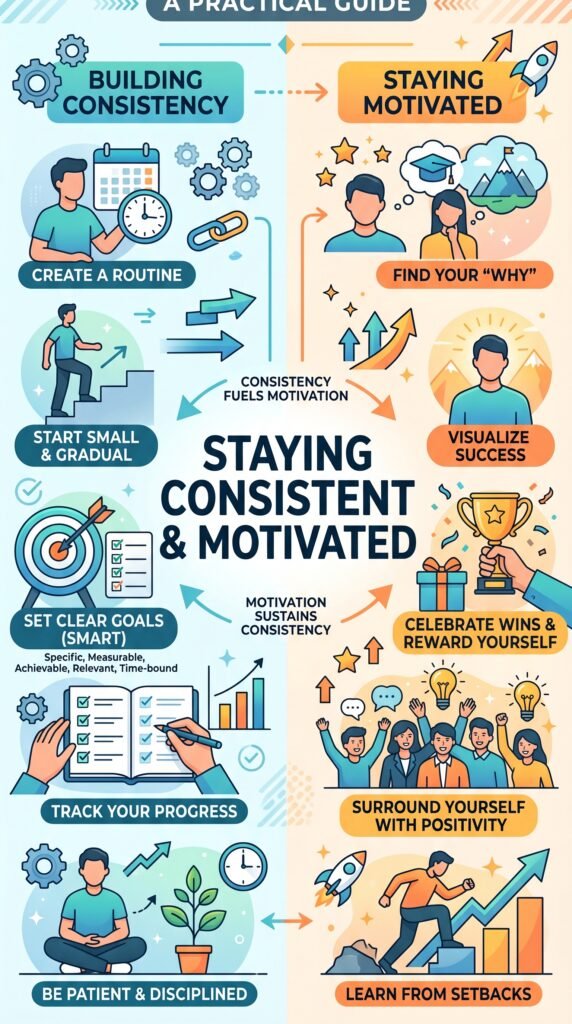
Knowing what to do and actually doing it consistently are two very different challenges. Here’s what genuinely works for long-term consistency in fitness — particularly for beginners.
Build identity before relying on discipline As covered in Tip 12, the most consistent people identify as someone who exercises — not someone who is trying to exercise. That identity shift makes showing up feel like self-expression rather than self-punishment.
Design your environment for success Put your workout clothes next to your bed the night before. Keep a water bottle on your desk. Set your alarm 30 minutes earlier on workout mornings. Remove friction from the decision to exercise and add friction to the decision to skip.
Use the “2-minute rule” on hard days On days when motivation is genuinely low, tell yourself you only have to work out for 2 minutes. Put on your clothes, start the warm-up, and give yourself permission to stop after 2 minutes if you still want to. You almost never will — starting is the hardest part.
Celebrate small wins loudly Completed your first full week? That deserves acknowledgment. Managed your first real push-up? That’s a genuine achievement. Your brain responds to positive reinforcement — use it deliberately.
Plan for disruption Life will get in the way. Travel, illness, work stress, family obligations — these are inevitable. Have a “minimum viable workout” ready for disrupted weeks: 15 minutes, 3 exercises, done. Something always beats nothing.
💡 A Short Note on Motivation and Transformation
Here’s something worth saying plainly: you will not always feel motivated. There will be mornings when the alarm goes off and every part of you wants to skip the workout. There will be weeks when progress feels invisible and the whole effort feels pointless.
Those moments are not signs that fitness isn’t for you. They’re signs that you’re human.
The people who transform their bodies and their health are not the ones who feel motivated every day. They’re the ones who built systems strong enough to carry them through the days when they don’t.
Every completed workout on a day you didn’t want to do it is worth ten times more than a workout on a day you were fired up. Those are the reps that build real discipline. Those are the sessions that build real character.
You are capable of this. The only question is whether you’ll give yourself enough time and consistency to find out.
FAQs: Fitness Tips for Beginners
Q1: How many days a week should a complete beginner work out?
Three days per week is the ideal starting point for most beginners. This frequency is enough to build fitness and momentum without overwhelming your body before it has adapted. After 4–6 weeks of consistent three-day training, you can progressively increase to four or five days as your recovery improves. Quality and consistency over those three sessions matters far more than frequency in the early stages.
Q2: Do I need to go to a gym to get fit as a beginner?
Absolutely not. Some of the most effective fitness tips for beginners involve zero gym access. Bodyweight exercises performed consistently at home — squats, push-ups, lunges, planks, and glute bridges — build genuine strength, improve cardiovascular fitness, and transform body composition. The gym is a tool, not a requirement. Start wherever you have access and comfort.
Q3: How long before I start seeing results from working out?
Most beginners notice improved energy and mood within 1–2 weeks. Cardiovascular improvements become noticeable around weeks 3–4. Visible changes in body composition typically appear between weeks 6–12, depending on diet, consistency, and starting point. The critical window is weeks 2–4, when motivation often dips but results are just around the corner. Push through this phase and the results begin to compound.
Q4: What should I eat before and after a workout as a beginner?
Before a workout (1–2 hours prior): a small, easily digestible meal with carbohydrates and protein. Good options include banana with peanut butter, Greek yogurt with fruit, or oatmeal with a boiled egg. After a workout (within 1–2 hours): a protein-rich meal to support muscle repair. Chicken with rice and vegetables, a protein smoothie, or cottage cheese with fruit all work well. Staying hydrated before, during, and after is equally important.
Q5: Is soreness after working out normal? How long should it last?
Yes — muscle soreness after exercise (called DOMS, or Delayed Onset Muscle Soreness) is completely normal for beginners and typically peaks 24–48 hours after a workout. It’s caused by microscopic muscle fiber damage that triggers the adaptation and growth response. Light soreness that fades within 72 hours is normal and expected. Sharp pain in joints, severe soreness that prevents normal movement, or pain that worsens rather than improving — those warrant rest and potentially medical attention.
Q6: What’s the most important fitness tip for beginners?
If you could only act on one piece of advice from this entire article, it would be this: start small and be ruthlessly consistent. The biggest predictor of long-term fitness success isn’t the program you follow, the gym you join, or the supplements you take. It’s whether you show up consistently over months — even imperfectly. Three mediocre workouts per week for six months will produce better results than three perfect workouts per week for three weeks followed by quitting. Consistency is everything.
Conclusion
You came here looking for fitness tips for beginners — and you found them. But more than tips, you now have a complete roadmap: a clear starting strategy, 12 detailed principles, a practical weekly plan, the mistakes to avoid, and the mindset tools to make it last.
The gap between where you are now and where you want to be is not as large as it feels. It’s bridged by consistent small actions taken over time — exactly what starting fitness for beginners is all about.
Here’s your action plan for today:
- Schedule your first three workouts in your calendar right now — specific days, specific times
- Choose 5 exercises from this guide as your starting routine
- Prepare your environment — lay out your workout clothes tonight
- Write down your “why” — keep it somewhere visible
That’s it. Four steps. Everything else comes from showing up and repeating.
The hardest workout is your first one. The second is easier. The tenth feels like a habit. The hundredth feels like who you are.
Your fitness journey starts the moment you decide it does.
That moment is now. Let’s go. 💪